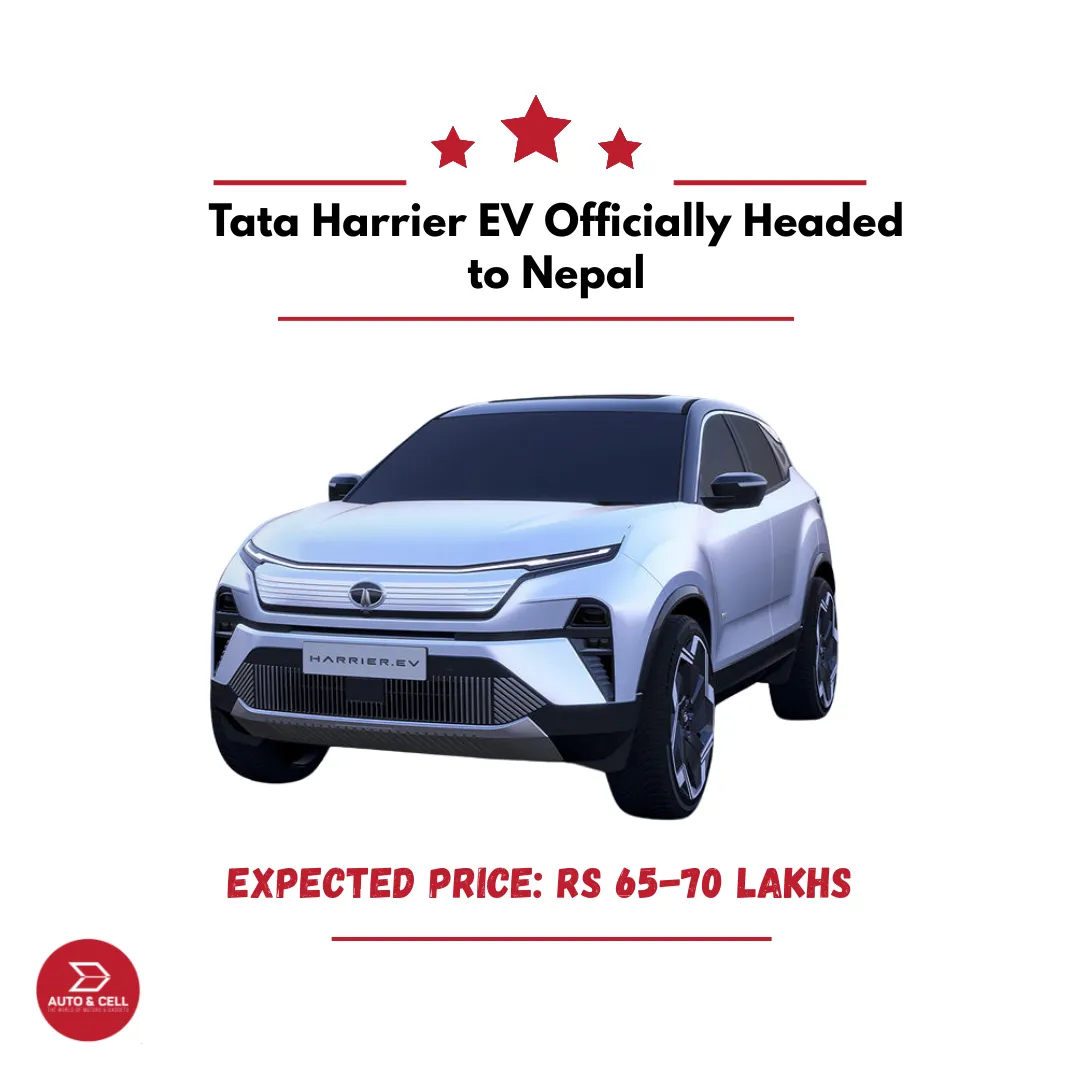
Tata Motors is bringing its flagship electric SUV, the Tata Harrier EV, to Nepal by late 2025. Unveiled in India on June 3, 2025, the Harrier EV combines rugged SUV capability with Tata’s next-gen electric vehicle technology. Its Nepal launch will be handled by Sipradi Trading, the official Tata distributor, following the momentum built by the Tata Curvv.ev.
More than just another EV, the Harrier EV signals Tata’s push into the premium electric SUV category with advanced AWD performance, long-range batteries, and a design inspired by Land Rover’s D8 platform. Positioned as a powerful yet practical electric SUV, it's expected to shake up Nepal's EV market with a compelling mix of performance, comfort, and tech.
Design
The Tata Harrier EV remains true to its diesel predecessor’s muscular stance while embracing clean EV aesthetics. It’s based on Tata’s Gen 2 EV architecture, adapted from the Land Rover-derived OmegaArc platform. Visually, it brings a fresh front fascia featuring a closed grille, vertical chrome inserts, and full-width LED DRLs.
A coupe-like roofline gives it a modern, athletic silhouette, while 19-inch turbine-style alloy wheels improve both style and aerodynamics. The black window trim and dual-tone finish enhance road presence, and the connected LED tail lamps add a sleek, unified look at the rear.
The Harrier EV is offered in four bold color options:
-
Nainital Nocturne
-
Pure Grey
-
Pristine White
-
Empowered Oxide
With a gesture-controlled powered tailgate, roof spoilers, and high clearance, the Harrier EV combines practical ruggedness with premium styling.
Interior
Step inside the Harrier EV and you’re welcomed by a premium dual-tone cabin wrapped in soft-touch materials and leatherette upholstery. A 14.5-inch QLED touchscreen, sourced from Samsung, dominates the dash and is paired with a 10.25-inch digital instrument cluster.
The front seats are power-adjustable, ventilated, and heated. Rear passengers benefit from Boss Mode, allowing rear seat recline and control. Tech integration continues with a Digital IRVM, dual-zone climate control, cooled glovebox, and wireless charging pad.
Infotainment is powered by a 10-speaker JBL audio system, with voice controls, seamless smartphone connectivity, and USB-C fast-charging ports for front and rear passengers. A panoramic sunroof adds openness to the cabin, completing the EV’s luxury profile.
Performance
The Harrier EV will come in two battery pack options, 65 kWh and 75 kWh, both using Lithium Iron Phosphate (LFP) cells. The 65 kWh version supports RWD, powered by a 175 kW motor producing 238 PS.
The 75 kWh variant offers both RWD and AWD configurations, making it India’s first AWD electric SUV. In AWD mode, the Harrier EV combines a 175 kW rear motor with a 115 kW front motor to deliver 317 PS and 540 Nm of torque. It accelerates from 0–100 km/h in just 6.3 seconds.
Range and Charging
The larger 75 kWh battery enables a MIDC-certified range of up to 627 km for the RWD model, and 622 km for the AWD. The RWD C75 model offers 480–505 km under real-world conditions.
Charging times via 7.2 kW AC charger:
-
65 kWh: ~10 hours
-
75 kWh: ~11.5 hours
DC fast charging specs are expected to be released soon.
Safety and Tech
The Tata Harrier EV includes a comprehensive safety and driver assistance suite. Key features include:
-
6 Airbags
-
Electronic Stability Program (ESP)
-
360-Degree Camera with Transparent Chassis View
-
Hill Hold and Hill Descent Control
-
ADAS (Advanced Driver Assistance Systems)
-
Auto Park Assist & Summon Mode
-
Regenerative Braking (4 Levels)
With six terrain modes (Normal, Snow, Mud, Sand, Rock, Custom) and dedicated Drift Mode on AWD, the Harrier EV is ready for Nepal’s hills, city roads, and everything in between.
Dimensions and Practicality
The Harrier EV is built for size and presence. Key dimensions include:
-
Length: 4607 mm
-
Width: 2132 mm
-
Height: 1740 mm
-
Wheelbase: 2741 mm
-
Ground Clearance: 205 mm
-
Kerb Weight: ~1900–2000 kg
Cargo space is ample, with 502 liters of boot space and an additional 67-liter frunk for front storage. The 5-seater configuration makes it practical for both families and urban professionals.
Tata Harrier EV Price in Nepal
While Tata has yet to confirm the official price, the expected range is Rs. 65 to 70 lakhs, based on Indian pricing. With features like AWD, terrain modes, and premium interiors, the Harrier EV is poised to be a top-tier electric SUV offering in Nepal.
|
Variant |
Expected Price in Nepal |
Drivetrain |
Battery |
|
Harrier EV RWD |
Rs. 65,00,000–67,00,000 |
Rear-Wheel |
65 kWh |
|
Harrier EV AWD |
Rs. 68,00,000–70,00,000 |
All-Wheel |
75 kWh |
Bookings are expected to open once Indian deliveries begin in July 2025.
How Does It Compare to the Mahindra XUV.e9?
The Harrier EV’s closest rival is the Mahindra XUV.e9, another upcoming premium electric SUV. While Mahindra offers a futuristic design and a unique triple-screen dashboard layout, it lacks AWD, a major advantage for the Harrier EV. Tata also provides a larger infotainment screen, more terrain modes, and innovative features like Transparent Chassis View and Summon Mode.
Mahindra’s ground-up EV design is noteworthy, but Tata’s proven platform and wider feature set give it a clear edge in real-world usability.
Tata Harrier EV Features – At a Glance
-
175 kW RWD / 317 PS AWD Drivetrains
-
65 kWh / 75 kWh LFP Batteries
-
Up to 627 km MIDC Range
-
14.5-inch QLED Infotainment + 10.25-inch Digital Cluster
-
10-Speaker JBL Sound System
-
360° Camera with Transparent View
-
ADAS & 6 Terrain Modes
-
Wireless Charging, Digital IRVM, Boss Mode
-
Panoramic Sunroof & Leatherette Upholstery
-
Auto Park Assist & Summon Mode
Tata Harrier EV Specifications
|
Specification |
Value |
|
Power Output |
238 PS (RWD) / 317 PS (AWD) |
|
Torque |
540 Nm (AWD) |
|
Battery Capacity |
65 kWh / 75 kWh |
|
Estimated Range |
Up to 627 km (MIDC) |
|
0–100 km/h Acceleration |
6.3 seconds (AWD) |
|
Charging Time (AC 7.2kW) |
10–11.5 hours |
|
Ground Clearance |
205 mm |
|
Boot Space |
502L + 67L frunk |
|
Suspension |
McPherson (Front), Multi-link (Rear) |
|
Seating Capacity |
5 |
|
Tyres |
245/55 R19 Tubeless |
Is the Tata Harrier EV the Right Choice for Nepal?
Yes. The Tata Harrier EV offers long range, premium features, and rugged performance, making it ideal for urban commuters and adventure seekers alike. With AWD, off-road modes, and an electric platform tuned for Indian and Nepali conditions, it brings a level of practicality rarely found in premium EVs.
As the EV infrastructure in Nepal improves, the Harrier EV arrives at the right time, with the right balance of power, range, and luxury.
When Will the Harrier EV Launch in Nepal?
While the official booking dates for India start in July 2025, the Harrier EV is expected to enter the Nepalese market by the end of 2025. Sipradi Trading is expected to start promotional campaigns and demo displays once Indian deliveries begin. With Tata building momentum from the recent launch of the Curvv.ev, the Harrier EV is positioned as a flagship entry to reinforce Tata’s commitment to clean mobility in Nepal.
Conclusion
The Tata Harrier EV blends robust performance, premium design, and intelligent tech to set a new benchmark in the electric SUV segment for Nepal. With a powerful AWD option, long range, and a host of segment-first features, it positions itself as a strong contender in a fast-evolving market. As Tata continues to localize and electrify its portfolio, the Harrier EV could redefine what premium electric mobility looks like for the Nepalese consumer.
Frequently Asked Questions (FAQs)
Who is the official distributor of Tata Harrier EV in Nepal?
Sipradi Trading Pvt. Ltd.
What is the expected price of the Tata Harrier EV?
Between Rs. 65–70 lakhs, depending on variant and features.
What battery options are available in the Harrier EV?
65 kWh (RWD only) and 75 kWh (RWD and AWD).
Does the Harrier EV have AWD?
Yes, the AWD version features dual motors and 317 PS output.
How far can the Harrier EV go on a full charge?
Up to 627 km (MIDC) for the 75 kWh RWD variant.
When will the Harrier EV launch in Nepal?
Expected in late 2025 after Indian deliveries begin in July 2025.
Does it support fast charging?
Yes, although DC fast charge specifications are pending confirmation.
What are its top rivals in Nepal?
Mahindra XUV.e9 and upcoming premium EV SUVs.