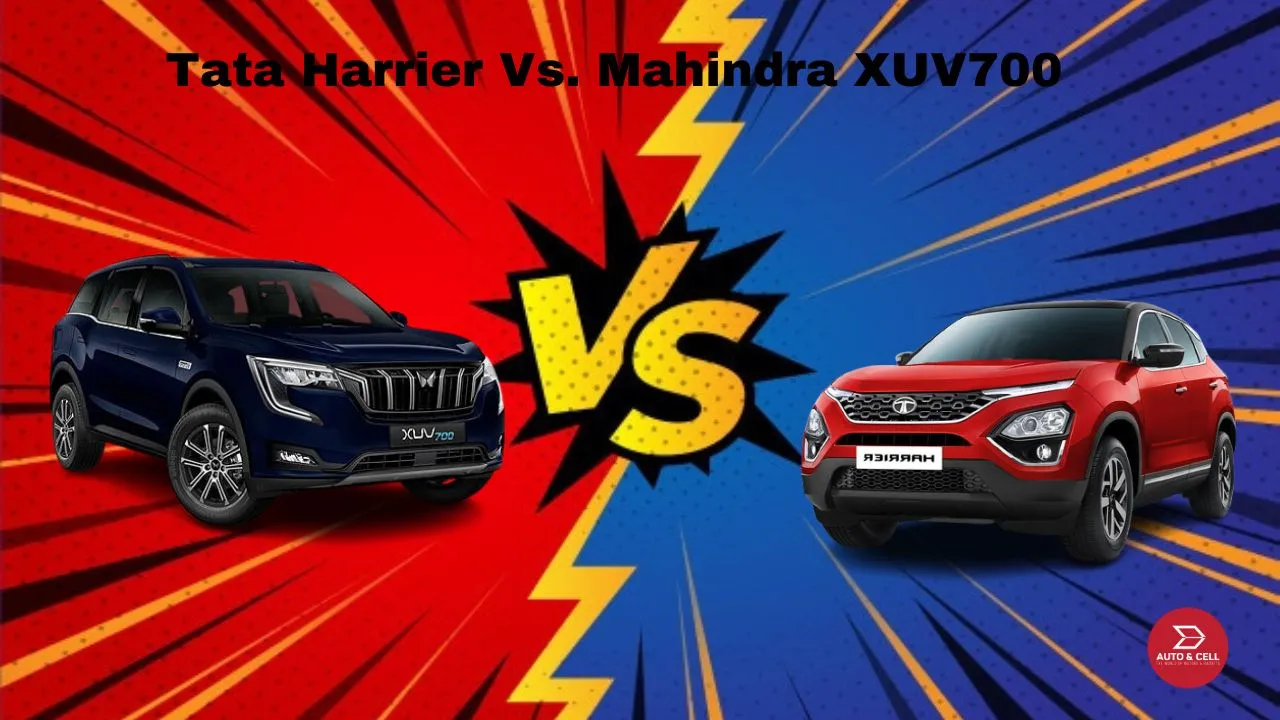
The newest talking point in the city is Mahindra's new SUV. Mahindra had record orders for the initial 25,000 units of the XUV700 in just 60 minutes, barely days after releasing the price list. A demonstration of why the XUV700 was the utmost eagerly awaited and exciting SUV introduction.
Conversely, since its introduction in 2019, the Tata Harrier has been driving the company's sales. No other SUV in Tata's lineup could match the sales volume recently achieved by this mid-size SUV, which was close to 50,000 units.
Both of the aforementioned mid-size SUVs are loaded to the gills with features. One is, nevertheless, more alluring than the other for a few vital reasons. What then are the root causes? In the following comparison review, let's find out.
Tata Harrier vs. Mahindra XUV700
|
Name |
Mahindra XUV700 | Tata Harrier |
|
Dimensions (L x W x H) |
4965mm x 1890mm x 1755mm | 4598mm x 1894mm x 1706mm |
|
Wheelbase |
2750mm | 2741mm |
|
Ground Clearance |
200mm | 205mm |
|
Boot Space |
240liters | 425liters |
|
Engine type |
Turbo Petrol with TGDi 2.0 Turbo Diesel with CRDi 2.2 |
Kryotec Turbocharged Diesel 2.0 |
|
Max Power |
200 PS @ 5000rpm 155 PS @ 3750rpm, 185 PS @ 3500rpm |
170 PS @ 3750rpm |
|
Max Torque |
380Nm @ 1750-3000rpm 360Nm @ 1500-2800rpm (MT), 420 Nm @ 1600-2800rpm (MT) and 450Nm @ 1750-2800rpm (AT) |
350Nm @ 2500rpm |
|
Suspension Setup |
Front- McPherson Strut Independent Suspension with FSD and Stabilizer bar Rear- Multi-Link Independent Suspension with FSD Stabilizer bar |
Front- Independent Lower Wishbone McPherson Strut with Coil Spring and Anti Roll bar Rear- Semi Independent Twist Blade with Panhard Rod and Coil Spring |
|
Tires |
235/60 R18, Tubeless |
235/60 R18, tubeless |
Design
The new XUV700 is longer and broader than the XUV500 and is built on the sW601 monocoque chassis. Its length is 4695 mm, and its wheelbase is 2750 mm. In contrast to the Tata Harrier, which is only offered with a 5-seat configuration, this provides the XUV700 the advantage of having both a 5-seat and a 7-seat configuration.
The XUV700 and XUV500 are visibly similar in terms of size and proportion. Nonetheless, the addition of the C-shaped DRLs has made the front fascia more obvious and sharp. The new Mahindra emblem is now visible on the chrome-stripped grille.
 Image Credit-carwale
The shoulder-door lines and genuine-looking pop-out door handles on the side will concurrently conjure up images of the XUV500. The tailgate is a sophisticated piece of plastic that is composed of many plastic compositions. Nevertheless, the XUV700 does give off a luxury product vibe, and the sheet metal also appears pricey.
The Harrier, on the other hand, has aspects from Tata's crisp Impact 2.0 design language, including its recognizable hexagonal shapes. The D8 monocoque platform from Land Rover, which is also used in Discovery Sport, is the foundation for both the XUV700 and the Harrier. Particularly with the front fascia, the relationship to the H5X idea is obvious.
The unconventional aspect of the design is highlighted by the way the LED DRL and turn indicators cut straight through the bonnet and the headlight assembly is pushed down to the bumpers. The design of the Harrier also has a certain sporting flair, particularly in the way the C-pillar joins the sloped roofline and the raising window level.
 Image Credit-carwale
The elegant taillamps on both sides and the lengthy, dark crome-styled strip on the back contribute to the vehicle's expensive appearance. The Harrier's lower side body skirts and 205 mm of ground clearance further contribute to its off-road look.
Note: Premium options include both the XUV700 and the Harrier. The Harrier is the complete opposite, with a construction quality appropriate for off-road conditions, whereas the XUV700 is much more road-centric on the outside.
Performance
Both gasoline and diesel engines, as well as a six-speed automatic or manual transmission, are available for the Mahindra XUV700. At 5000 rpm, the standard 2.0-liter turbocharged petrol engine can generate a maximum of 200 PS and 380 Nm of torque. In contrast, there are three tuning levels for the 2.2-liter turbo diesel engine.
With the base MX trims, you can get the lowest 155 Ps and 160 Nm of torque. In contrast, the AX models' version of the same engine, with a 6MT, makes 185 PS and 420 Nm of torque. 450 Nm of torque is produced together with the same power by the 6-speed automated transmission.
On the other hand, the Tata Harrier only offers one engine choice across all trim levels. The 2.0-liter diesel engine, which is sourced from Fiat, has a 6-speed manual or 6-speed automatic transmission and generates 170 horsepower and 350 pound-feet of torque.
Both SUVs have different driving modes, including City, Eco, Sport and Zip, Zap, and Zoom. Tata makes it sound like a conventional firm, but Mahindra maintains its name focused on millennials.
Moreover, both SUVs include active terrain management systems; however, Tata's system focuses more on managing engine power and torque. The XUV700 performs the same function, but its higher grade also has an all-wheel drivetrain, which is a big distinction.
Note: The Harrier is less adaptable than the Mahindra because there is just one diesel engine available, as opposed to the Mahindra's two petrol and diesel engines. Nonetheless, the 2021 Safari features a powerful drivetrain that can readily traverse any terrain.
Features
Beginning with the base MX model, which comes with an 8-inch touchscreen infotainment system and a 7-inch driver's dashboard, the Mahindra XUV700 is packed with goodies. All XUV700 SUVs include a 10.25-inch digital dashboard starting with the AX3 model.
 Image Credit-cartrade
In addition to having a base 6-speaker sound system that can be expanded to a 12-speaker Sony sound system, the infotainment system supports both Apple CarPlay and Android Auto.
Around 60 automotive functionalities, including ones like, are included with the AdrenoX-connected car AI technology that is currently accessible. Some of the few amenities that come standard in all XUV700 SUVs include pre-heating the cabin, remote start/stop by smartphone or watch, and driver drowsiness monitoring.
The Harrier, on the other hand, has a horizontally oriented 8.8-inch touchscreen infotainment system and a semi-digital 7-inch TFT display for the driver's dash. The device is compatible with Android Auto and Apple CarPlay.
A sunroof is also included in both the Harrier and XUV700, although, unlike the XUV, its standard 4-speaker system is not as captivating. The JBL sound system, however, is worth mentioning because it is included in the top Harrier variants.
 Image Credit-news18
With its extensive list of safety features and the ability for semi-autonomous driving, Mahindra takes the prize in this comparison. Your lane-keep assist, lane departure warning, automatic emergency braking, and adaptive cruise control are all provided by the camera-based ADAS (Advanced Drivers Assistance System).
The best features of the Harrier's top model include ESP, hill descent control, rollover mitigation, brake disc wiping, and traction control. The XUV700 has seven airbags as standard equipment, compared to the Harrier's twin airbags, and it also has curtain airbags on higher trim levels that reach as high as the third row.
Note: The feature list for the Harrier is remarkable, but it isn't as long or as cutting-edge as the one offered with the XUV700.
Price
There are many model levels, dual-tone paint options, and automatic and manual transmission options for the Tata Harrier. The most costly Harrier model is the XZA Plus Dark Edition with the automatic gearbox option, with a beginning ex-showroom price of Rs. 21 Lakhs.
The range begins with the entry-level XE model, which has a starting ex-showroom price of Rs. 14.40 Lakhs. The XUV700, on the other hand, offers both gasoline and diesel engine choices.
The base MX models for diesel and petrol are both priced ex-showroom at Rs. 12.99 Lakhs and Rs. 12.49 Lakhs respectively. The AX7 variant, which comes next, has a premium pack and standard all-wheel drive and has an ex-showroom pricing of Rs 22.99 Lakhs, while the petrol version starts at Rs 21.29 Lakhs further down the lineup.
|
Mahindra XUV700 |
Tata Harrier |
|
Starting from INR. 14 Lakhs to INR. 25.48 Lakhs |
Starting from INR. 15 Lakhs to INR. 22.60 Lakhs |
Conclusion
Both the Harrier and the XUV700 are significant items for their respective makers. The Harrier, on the other hand, deviates sharply from the norm for a Tata car and has a sleek, contemporary appearance. The XUV700 raises the bar thanks to its improved feature set and partially autonomous driving capabilities.
When comparing cars based on the number of amenities they offer, the XUV700 comes out on top. Yet, the Tata Harrier has a better SUV posture and higher clearance from the ground. However, as no all-wheel drive is available, the Harrier falls short of the XUV700 in this situation as well.
So, if you had to choose between the Tata Harrier and the XUV700, which car would you choose? Please share your thoughts in the comment area.
>>>You May Also Like-Tata Nexon, Harrier, and Safari to Get a New ‘Red Dark’ Edition: Official Teaser<<<
>>>Mahindra XUV400 receives over 15000 bookings within 13 days<<<
>>>Top 5 Best Selling mid-size SUVs in India [January 2023 Sales]<<<
Join us on Facebook for insights on the latest updates on automobiles and gadgets: Autoncell
Also, follow us on our other Social Media Handles:


-original.webp)